Unlocking Urban Biodiversity: How Drones Are Transforming Community Garden Monitoring
New study combines spectral and structural data to assess plant diversity in urban ecosystems
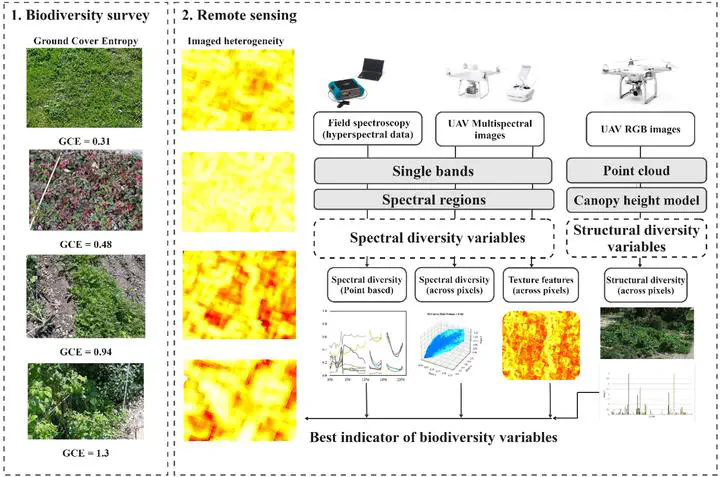 Urban community garden biodiversity monitoring
🌿 Advancing Urban Biodiversity Monitoring
We’re excited to share our latest research (Afrasiabian et al. 2025) published in Remote Sensing Applications: Society and Environment, where we explore innovative approaches to monitoring biodiversity in urban community gardens using cutting-edge remote sensing technologies!
🔬 The Innovation
Urban community gardens are vital green spaces that support biodiversity and ecological functioning in cities. However, these managed environments present unique challenges for biodiversity assessment due to their complex mix of vegetative and non-vegetative ground cover components.
Our study, led by Yasamin Afrasiabian in collaboration with researchers from Technical University of Munich and Leiden University, demonstrates how combining drone-based multispectral imagery, in situ hyperspectral measurements, and 3D canopy height models can effectively capture plant and ground cover diversity.
🎯 Key Findings
✨ Spectral ranges matter: Red-Edge and Near-Infrared (NIR) bands effectively captured compositional variation in ground cover, while visible wavelengths better reflected subtle differences in vegetative components.
✨ Structure adds value: Texture features and height-based structural variables provided valuable insights into canopy complexity, particularly improving predictions of plant abundance and ground cover entropy.
✨ Better together: Integrating spectral and structural diversity variables significantly enhanced predictive performance, outperforming single-source analyses. This highlights the value of combining complementary remote sensing data streams.
✨ Non-vegetative components count: The study reveals how artificially managed ground cover types, including both vegetative and non-vegetative components, influence spectral diversity in ways different from natural systems.
🌍 Real-World Impact
This research was conducted across five urban community gardens over two years, examining multiple biodiversity variables including:
- Plant species richness
- Total plant abundances
- Ground cover entropy
- Ground cover richness
The findings demonstrate that a multi-metric approach combining spectral diversity (Spectral Variation Hypothesis) with structural diversity (Height Variation Hypothesis) is essential for comprehensive biodiversity monitoring in complex urban ecosystems.
🚀 Why This Matters
As cities continue to expand globally, urban green spaces like community gardens play increasingly important roles in:
- 🌱 Supporting local biodiversity
- 🏙️ Enhancing ecosystem services
- 👥 Providing community benefits
- 🌡️ Mitigating urban heat effects
Our research provides practical tools and insights for urban planners, conservation managers, and community garden practitioners to better monitor and manage these urban ecosystems using digital and remote sensing technologies.
📖 Read the Full Study
The article is now available as open access:
📄 Afrasiabian, Y., Contiz, F., Van Cleemput, E., Egerer, M., & Yu, K. (2025). Biodiversity monitoring in urban community gardens using proximal sensing and drone remote sensing. Remote Sensing Applications: Society and Environment, 39, 101685.
This research contributes to our lab’s broader mission of developing innovative remote sensing solutions for sustainable agriculture and vegetation ecosystems. Congratulations to Yasamin and the entire research team on this important contribution!
#UrbanBiodiversity #DroneRemoteSensing #CommunityGardens #UrbanEcology #PrecisionAgriculture #SustainableCities

Drone Pag
Drone of Artificial Intelligence
My research interests include robotics, mobile computing and AI.

Yasamin Afrasiabian
PhD student
My research interests include remote sensing, particularly hyperspectral UAV and satellite imaging, and machine-learning methods for ecosystem-biodiversity characterisation, precision agriculture, and hydrological analysis.
Prof. Dr. Kang Yu
Professor of Precision Agriculture
My research interests include precision crop farming, hyperspectral remote sensing, and AI in agriculture.