From 10 Bands to Over 2000: Hyperspectral Crop Sensing from a Multispectral Drone
A physics-guided deep learning framework, M2H-SWIR, reconstructs full hyperspectral reflectance — including the nitrogen-sensitive shortwave infrared — from everyday UAV multispectral cameras.
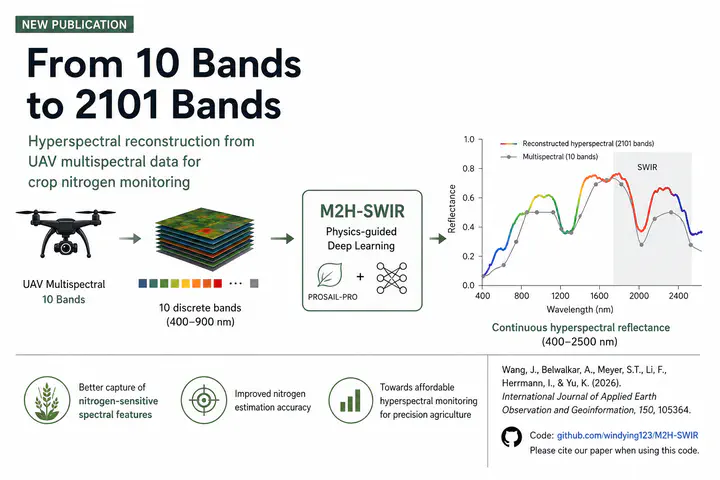 M2H-SWIR reconstructs continuous hyperspectral reflectance (400–2500 nm) from a 10-band UAV multispectral image for crop nitrogen monitoring.
What if an everyday (low-cost) drone multispectral camera could see almost as much as a research-grade hyperspectral sensor? In a new study published in the International Journal of Applied Earth Observation and Geoinformation, Jie Wang, Anirudh Belwalkar, and Kang Yu, together with collaborators, show how to get there — turning 10 broad bands into over 2000 continuous narrow bands.
📄 Read the paper: Wang et al. (2026), Int. J. Appl. Earth Obs. Geoinf., 150, 105364.
Why it matters
Knowing how much nitrogen a crop holds is central to precision fertilization, higher yields, and less waste. Hyperspectral sensors capture the fine spectral detail that reveals nitrogen status — but they are costly and operationally complex, which keeps them out of most farms and field trials.
Multispectral UAV cameras are the opposite: affordable and everywhere, but they record only a handful of broad bands. Crucially, they miss the shortwave infrared (SWIR) region, where some of the most informative nitrogen-sensitive features live.
What we did
We built M2H-SWIR — a framework that pairs physics with deep learning to reconstruct continuous hyperspectral reflectance (400–2500 nm) from ordinary UAV multispectral imagery. It brings together:
- 🌱 Physics-based canopy simulation with the PROSAIL-PRO radiative transfer model;
- 🧠 Deep neural networks that learn the multispectral-to-hyperspectral mapping;
- 🔦 Explicit reconstruction of the SWIR, recovering nitrogen-sensitive absorption features the camera never measured directly;
- 🌾 Field validation against spectrometer measurements in winter wheat experiments.
Key findings
- A 10-band UAV image can be expanded into continuous reflectance across the visible, near-infrared, and SWIR;
- M2H-SWIR outperformed conventional radiative-transfer inversion approaches;
- The reconstructed spectra preserved the nitrogen-sensitive absorption features that matter for crop diagnostics;
- Nitrogen estimates from the reconstructed hyperspectral data were more accurate than those from the raw multispectral bands.
Looking forward
M2H-SWIR points toward affordable hyperspectral monitoring: the spectral richness of a lab-grade sensor, from hardware many groups already fly. We hope it lowers the barrier to high-quality crop nutrient sensing in research and practice alike.
The code is open source, and we warmly invite others to test the framework on independent datasets, other crops, and different sensors. The study was based on the MicaSense Dual-camera system, but the framework should be applicable to other multispectral cameras.
🔗 Paper: https://doi.org/10.1016/j.jag.2026.105364 💻 Code: https://github.com/windying123/M2H-SWIR
Congratulations to Jie Wang and co-authors — Anirudh Belwalkar, Sebastian T. Meyer, Fei Li, Itai Herrmann, and Kang Yu.
— TUM Precision Agriculture Lab

Drone Pag
Drone of Artificial Intelligence
My research interests include robotics, mobile computing and AI.