Joint UGA–TUM Seminar on Integrative Precision Agriculture
On 10 June 2026, the TUM Precision Agriculture Lab (PAG Lab) together with Chair of Organic Agriculture hosted a full-day joint seminar with the University of Georgia (UGA, Athens, USA) at the Weihenstephan campus. Colleagues from UGA and TUM spent the day exchanging recent work spanning variable-rate management, precision irrigation, satellite and UAV remote sensing, field phenotyping, smart farming apps, and digital nutrient management — a broad sweep across two continents and several cropping systems.
The seminar was held under the framework of GlobalNitroLink, a TUM–UGA international exchange project funded through the BayIntAn programme of the Bavarian Research Alliance (BayFOR), which supports new research partnerships between Bavarian universities and leading international institutions.
Recent Developments from Georgia
The morning opened with two talks from our UGA guests.
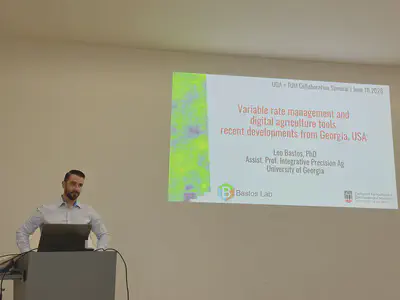
Dr. Leo Bastos, a Professor in Integrative Precision Agriculture at UGA, presented “Variable rate management and digital agriculture tools: recent developments from Georgia, USA.” His group works at the intersection of proximal and remote sensing, geospatial soils, and temporal weather data to inform crop management from within-field to regional scales, with a particular focus on nitrogen fertilizer management and crop quality mapping.
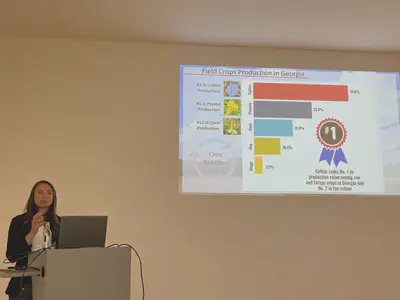
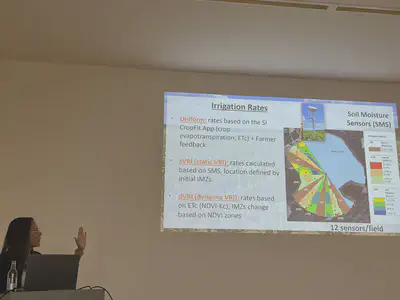
Dr. Lorena Lacerda, a Professor in Integrative Precision Agriculture at UGA, followed with a tour of the Georgia production environment and precision irrigation. Starting from Georgia’s field-crop landscape, the talk moved into variable-rate irrigation (VRI) with center-pivot systems: soil-moisture-sensor networks, static and dynamic VRI strategies, zone- and nozzle-level control. Her broader interest lies in UAV and satellite remote sensing to capture soil–plant–environment interactions and their spatial and temporal variability.
Precision Sensing at TUM
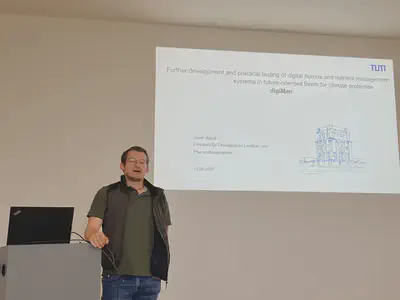
In the late morning, colleagues from the **TUM Chair of Organic Farming ** presented the digiMan project — “Further development and practical testing of digital humus and nutrient management systems in future-oriented farms for climate protection.” Josef Stangl and Ludwig Hagn walked through the project’s goals and its digiMan Hub, which turns field data into zone-based nutrient management recommendations, linking soil carbon and nutrient management to climate protection on working farms.

Digital Nutrient Management for Climate-Friendly Farming
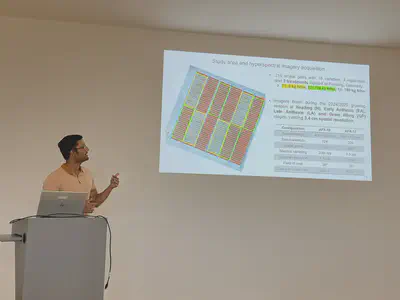
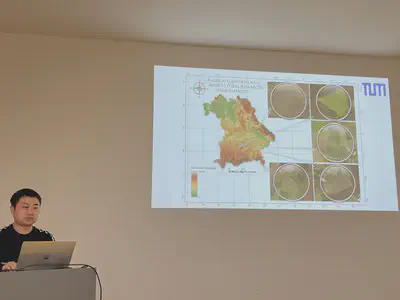
In the afternoon, members of the TUM Precision Agriculture Lab — including Anirudh Belwalkar and Dong Bai — shared current work on UAV- and sensor-based crop monitoring. Talks covered hyperspectral imaging of wheat nitrogen experiments at our Dürnast and Roggenstein sites — hundreds of plots across varieties and N treatments imaged through key growth stages at centimetre-scale resolution — and the network of agricultural research field stations across Bavaria that anchors our field campaigns.
Connections and Next Steps
The seminar fit naturally into a growing transatlantic network in integrative precision and digital agriculture. Just last month, TUM alumnus Prof. Christian Bredemeier (UFRGS, Brazil) — who previously hosted Dr. Bastos as a visiting professor — gave a guest lecture at Weihenstephan, and Dr. Bastos himself joined our BIGSTAR workshop at TUM in November 2025. These overlapping circles between Athens (GA), Weihenstephan, and Porto Alegre make joint research on sensor-based nitrogen and water management, variable-rate technologies, and UAV phenotyping — together with student exchange — natural next steps.
The exchange continues straight away: as the reciprocal leg of the GlobalNitroLink collaboration, the TUM team will visit the University of Georgia in July 2026 to continue the conversations started in Weihenstephan and to plan the next steps together on the ground in Athens.
Thanks
Thank you to our colleagues from the University of Georgia for two excellent talks, to TUM colleagues for joining the day and helpign organize and present. We look forward to building on these connections.
— TUM Precision Agriculture Lab

Drone Pag
Drone of Artificial Intelligence
My research interests include robotics, mobile computing and AI.