Seeing Photosynthesis from a Drone: Physics-Informed AI for Wheat
Combining PROSAIL physics, vegetation indices, and a Vision Transformer to predict photosynthetic traits, biomass, and yield in winter wheat from UAV multispectral imagery.
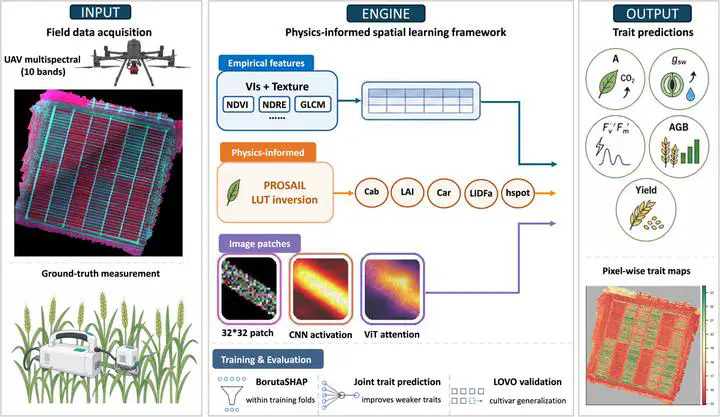 A physics-informed spatial learning framework links UAV multispectral imagery to leaf-level traits, producing pixel-wise maps of photosynthesis, biomass, and yield in winter wheat.
Photosynthesis drives crop growth and yield — yet measuring it in the field is slow, hands-on work, one leaf at a time. Can a drone do it instead? In a new study in the European Journal of Agronomy, Jingcheng Zhang and Kang Yu show how plant canopy-light interaction physics + AI + UAV imaging can read wheat physiology from the sky.
📄 Read the paper: Zhang & Yu (2026), Eur. J. Agron., 180, 128202.
Why it matters
Drone imagery is fast and covers many plots at once — ideal for breeding trials. But there’s a gap to bridge: cameras measure canopy reflectance, while photosynthesis is a physiological process happening inside leaves. Turning pixels into biology requires models that respect both.
What we did
We built a physics-informed machine learning framework to predict five key wheat traits from UAV multispectral (MicaSense) imagery: CO₂ assimilation rate, stomatal conductance, photosystem II efficiency, aboveground biomass, and grain yield. It combines:
- 📊 Vegetation indices and texture features from the multispectral images;
- 🌿 PROSAIL radiative transfer inversion, adding physics-based plant variables (e.g., chlorophyll, leaf area);
- 🤖 Spatial deep learning — a 2D-CNN and a Vision Transformer (ViT) that learn directly from image patches;
- 🎯 Multi-output learning to predict several related traits together.
Key findings
- UAV imagery can predict not only biomass and yield, but also harder-to-measure photosynthetic traits;
- PROSAIL-derived parameters add real value beyond standard vegetation indices;
- The Vision Transformer learned meaningful spatial patterns and performed strongly for yield prediction;
- Pairing physics with deep learning improved transferability across wheat varieties in several cases;
- Random Forest remained a robust baseline when generalizing to unseen varieties.
Looking forward
This work shows how plant canopy-light interaction physics, machine learning, and UAV imaging together can make field phenotyping far more scalable — screening crop performance across many plots instead of a few plants by hand. We hope it supports high-throughput wheat phenotyping and future breeding aimed at photosynthesis, biomass, and yield.
🔗 Paper: https://doi.org/10.1016/j.eja.2026.128202
Congratulations to Jingcheng Zhang and Kang Yu.
— TUM Precision Agriculture Lab

Drone Pag
Drone of Artificial Intelligence
My research interests include robotics, mobile computing and AI.