A New Global View of Vegetation Health from Space
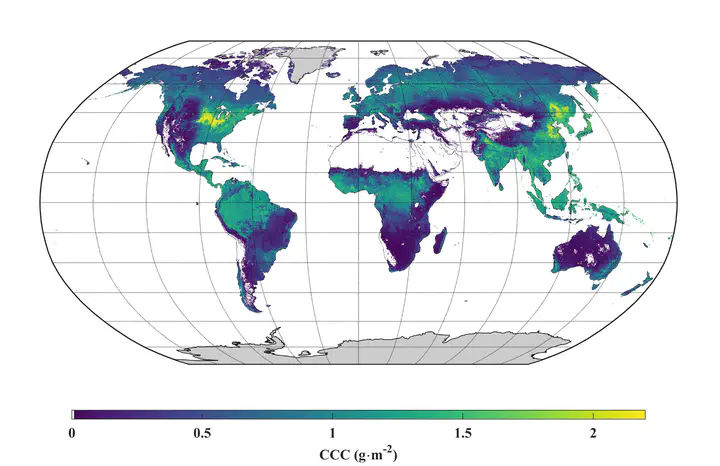 Global CCC
🌿 A New Global View of Vegetation Health from Space 🌍
Photosynthesis is the foundation of life on Earth — it’s how plants turn sunlight, water, and carbon dioxide into the energy that sustains ecosystems and agriculture. At the heart of this process is chlorophyll, the green pigment that captures sunlight.
The amount of chlorophyll in plant canopies tells us a lot about plant health, productivity, and how well ecosystems are functioning. Yet until now, there’s been no global, consistent, open-access dataset to monitor this key indicator.
The Precision Agriculture Laboratory at the Technical University of Munich has changed that. Our team and international collaborators have developed the world’s first global dataset of canopy chlorophyll content (CCC), using advanced analysis of observations from the European Sentinel-3 satellites.
By combining physical models with machine learning in a unique approach, we’ve overcome challenges like atmospheric interference and differences in landscapes around the world. The result is a high-resolution dataset (300 meters, updated every 8–10 days) covering the period from 2016 to 2024 — and it will continue to grow.
This new CCC dataset is a powerful tool for scientists, farmers, and policymakers. It can help:
✅ Estimate plant growth and carbon uptake
✅ Monitor crop conditions and inform precision agriculture
✅ Track how ecosystems respond to climate change
🔗 Learn more in our recent publication:
Li, D., Croft, H., Duveiller, G., Schreiner-McGraw, A.P., Belwalkar, A., Cheng, T., Zhu, Y., Cao, W., & Yu, K. (2025). Global retrieval of canopy chlorophyll content from Sentinel-3 OLCI TOA data using a two-step upscaling method integrating physical and machine learning models. Remote Sensing of Environment, 328, 114845. https://doi.org/10.1016/j.rse.2025.114845
Dr. Dong Li
Research Scientist
My research interests include vegetation remote sensing and precision agriculture.