NH3-Min: Reducing NH₃ Losses from Application of Synthetic Nitrogen Fertilizers and Increasing Nitrogen Use Efficiency of Fertilization
Overview
NH3-Min is a national consortium project funded through the Landwirtschaftlichen Rentenbank, coordinated by the Thünen Institute for Climate-Smart Agriculture. The project quantifies and evaluates ammonia (NH₃) losses from synthetic nitrogen fertilizers and develops evidence-based mitigation measures, while simultaneously assessing nitrogen use efficiency (NUE) in arable crop production.
Around 15% of agricultural NH₃ emissions in Germany originate from synthetic N fertilizers. The four fertilizer types investigated—urea, calcium ammonium nitrate (CAN), ammonium nitrate urea solution (UAN), and ammonium sulfate urea—together account for more than 85% of NH₃ emissions from synthetic N fertilizers applied in Germany. Winter wheat serves as the model crop across all experimental sites.
Objectives
- Quantify NH₃ emissions from different synthetic N fertilizer types and application systems across diverse German agro-climatic conditions.
- Evaluate mitigation options including incorporation/injection techniques and urease inhibitors.
- Derive site-differentiated NH₃ emission factors for synthetic N fertilizers under German production conditions.
- Assess NUE of different synthetic N fertilizers and application strategies in field crop experiments.
- Transfer knowledge to farmers, advisors, and policymakers.
Research Questions
- How large are NH₃ emissions following application of different synthetic N fertilizers?
- What are the site-differentiated NH₃ emission factors across Germany?
- How effectively can application techniques (e.g., incorporation, injection) or inhibitors (urease inhibitors) reduce NH₃ emissions?
- How do fertilizer-dependent NH₃ emissions affect yields, N uptake, and NUE in winter wheat?
Project Partners
- Thünen Institute for Climate-Smart Agriculture
- Technical University of Munich (TUM)
- Julius Kühn-Institut – Federal Research Centre for Cultivated Plants (JKI)
- KTBL – Association for Technology and Structures in Agriculture
- Christian-Albrechts-Universität Kiel
- Forschungszentrum Jülich
- Technische Universität Berlin
- Universität Hohenheim
- Bayerische Landesanstalt für Landwirtschaft (LfL)
- Ingenieurgemeinschaft für Landwirtschaft und Umwelt (IGLU)
- Landwirtschaftskammer Niedersachsen
- Stickstoffwerke Priesteritz (SKWP)
Duration: 01.2021 – 12.2024
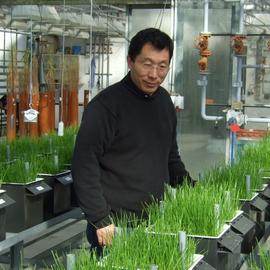
PD. Dr. Yuncai Hu
Senior Researcher
My research interests include Remote sensing, Precision N nutrient management, Plant phenotyping for complex traits of abiotic stress tolerance, Agricultural N emissions, and Physiological mechanisms of plant responses to abiotic stresses.