MSFFC: A novel dimensionality reduction method for improving maize nitrogen estimation from high-dimensional spectral reflectance data
Abstract
Due to strong inter-band correlations and redundancy, accurately extracting information related to crop canopy nitrogen content (CNC) from hyperspectral data remains challenging. To address this issue, this study proposes a multi-strategy feature fusion and compression (MSFFC) method that integrates optimal band subsets selected by different feature selection methods and further compresses redundant information using an autoencoder (AE). This design improves the retention of complementary spectral information while alleviating the influence of feature correlation on CNC inversion. Based on UAV hyperspectral images and CNC data from maize under different nitrogen fertilizer gradients during 2020-2022, fifteen feature selection methods were evaluated. Subsequently, AE was employed to compress the optimal single feature subset and the fused feature subset to reduce redundancy. Five commonly used machine learning models and the Tabular Prior-data Fitted Network (TabPFN) were employed as evaluation functions and modeling tools for the dimensionality reduction method. Although the successive projection algorithm (SPA) demonstrated the best performance among all feature selection methods, integrating SPA with AE did not further improve model accuracy. In contrast, MSFFC achieved a significant reduction in model RMSE, ranging from 0.9% to 38.7% while reducing full-band hyperspectral data by 97.6%. The robustness of models constructed using SPA and MSFFC features was compared on the external dataset, the PROSAIL-PRO simulation dataset, and the public dataset. The results showed that the quality of the input features has a greater impact on model performance than the dataset’s size. MSFFC mitigates the estimation limitations of traditional artificial neural network models in small-sample scenarios ($<$ 100 samples). Among all models, MSFFC-TabPFN demonstrated the best performance, achieving a 25.9%-123.2% improvement in the composite performance index (CPI). These results highlight the critical role of combining feature selection methods with nonlinear feature compression in hyperspectral research, providing essential methodological support for robust, generalizable crop parameter inversion models.
Hang Yin, Haibo Yang, Fei Li, Yuncai Hu, & Kang Yu (2026). MSFFC: A novel dimensionality reduction method for improving maize nitrogen estimation from high-dimensional spectral reflectance data. IEEE Journal of Selected Topics in Applied Earth Observations and Remote Sensing: 1-17.

Dr. Haibo Yang
Lecturer (current)
My research interests include hyperspectral remote sensing, precision agriculture, and nitrogen nutrient management.
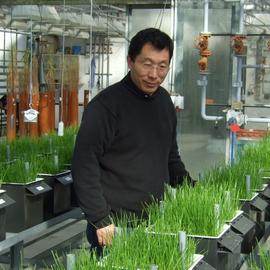
PD. Dr. Yuncai Hu
Senior Researcher
My research interests include Remote sensing, Precision N nutrient management, Plant phenotyping for complex traits of abiotic stress tolerance, Agricultural N emissions, and Physiological mechanisms of plant responses to abiotic stresses.

Prof. Dr. Kang Yu
Professor of Precision Agriculture
My research interests include precision crop farming, hyperspectral remote sensing, and AI in agriculture.